
That commercial building you love could come with an insurance bill that changes the whole deal. Before buying, verify property-specific availability and get written terms for commercial property insurance in Georgia while you still have time to negotiate.
For a Savannah storefront or Pooler warehouse, verify that coverage is available for the specific property before making a purchase decision. A workable purchase needs coverage you can obtain, deductibles you can afford, and limits that protect your investment.
Let’s start with what you’re buying protection for.
Key Takeaways
- Obtain property-specific insurance terms before your due diligence period expires.
- Base building limits on current rebuilding costs, not the purchase price or tax assessment, to reduce the risk of being underinsured.
- Include flood coverage, storm deductibles, and code-upgrade protection in your acquisition budget.
The seller’s premium is background information. Your ownership, intended use, and coverage requirements determine the terms of your purchase.
What Commercial Property Insurance Covers in Georgia
Commercial property insurance, or business property insurance, protects physical assets against covered losses. Business income coverage can replace lost income and help pay continuing expenses after covered damage interrupts operations, but it must be included in the policy.
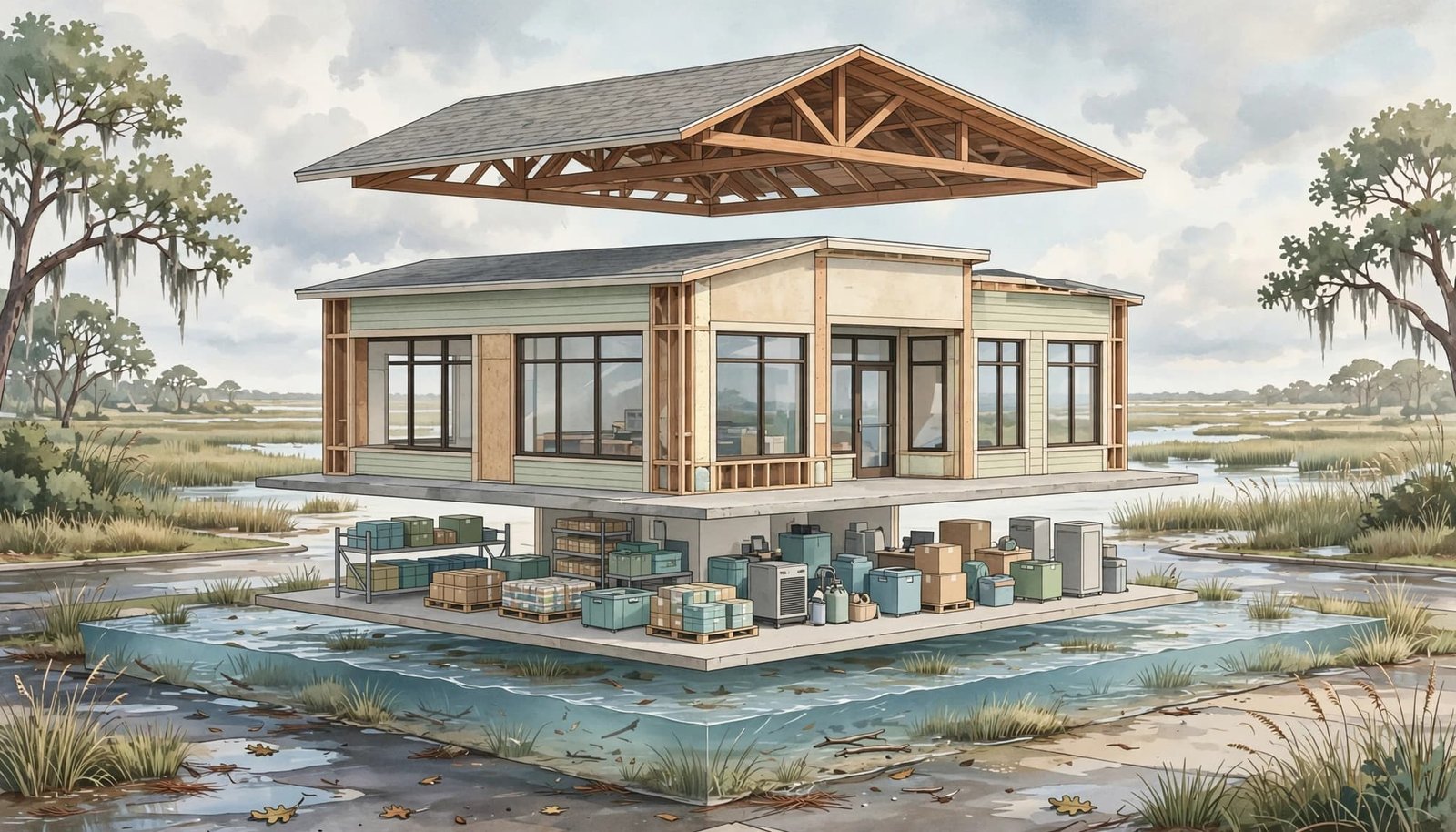
Separate the building from the business contents
Building coverage applies to the structure and covered permanent fixtures. Business personal property coverage applies to contents such as furniture, equipment, and inventory.
Property belonging to customers or others in your care, custody, and control may also be covered. Limits and conditions matter, particularly for repair shops, warehouses, and businesses storing customer goods.
Standard forms generally cover business personal property at the described premises or within 100 feet. Tools, equipment, or inventory traveling off-site often need inland marine insurance.
Understand the causes of loss form
The causes of loss form determines which events trigger coverage.
| Form | What it covers |
|---|---|
| Basic | Listed causes of loss, commonly including fire and certain storm damage |
| Broad | Named perils plus falling objects, snow or ice weight, and certain plumbing or appliance water damage |
| Special | Causes of loss unless excluded |
A special causes of loss form offers broader coverage, but exclusions still apply. Standard policies exclude flooding and earthquakes, which require separate policies or endorsements. Equipment breakdown may also require separate protection.
Think about it, folks: covered property and a covered cause of damage are two different questions. Both need a clear answer.
Establish Insurance Availability Before Diligence Ends
When you’re reviewing a business for sale with real estate attached, the building’s condition affects more than repair costs. It can affect an insurer’s willingness to offer coverage.
Give underwriting the actual property details
Provide the address, square footage, construction type, occupancy, roof age, building systems, fire protection, and intended operations. Include carrier-issued loss runs showing the seller’s claims history.
A change in use deserves attention. A quiet office and a production operation present different exposures, even inside the same building.
Our commercial building inspection guide connects roof, HVAC, and parking conditions to acquisition risk. Those findings also help explain the property accurately to insurers.
An independent agency can approach multiple carriers. Insuramerica reports representing 19 carriers, including Travelers, The Hartford, Philadelphia Insurance Companies, Chubb, Hanover, and Zurich. The company also reports serving Georgia since 1972, but that doesn’t guarantee a carrier will insure a specific property.
Distinguish a quote from bound coverage
A preliminary estimate doesn’t establish that coverage will take effect. Review written terms for the buyer, property, intended use, causes of loss form, limits, deductibles, exclusions, and outstanding underwriting conditions.
Roof repairs, electrical updates, or an inspection may be required before binding. Put those requirements into the acquisition timeline.
A seller’s active policy doesn’t establish insurance availability for the buyer’s ownership and planned operations.
Have your attorney address insurance-related closing conditions before the diligence deadline. That gives you room to negotiate repairs, credits, or a different purchase decision.
Calculate Replacement Cost Before Choosing Limits
The purchase price includes market factors and land value. An insurance rebuilding estimate answers a different question: what would it cost to replace the covered structure today?
Build the estimate around today’s construction costs
Start with measured building area and current local construction pricing for comparable construction. Adjust for stories, finishes, roof type, HVAC, electrical, plumbing, fire protection, and specialized improvements.
Account for applicable professional fees and other covered rebuilding expenses. Keep land value separate, and address demolition and code upgrades through the appropriate coverage. Ordinance or law coverage can help pay for costs tied to code upgrades.
Our Georgia commercial property appraisal guide explains market valuation. An insurance estimate needs its own scope.
Insuramerica’s Georgia coverage guide reports that commercial construction costs rose more than 30% since 2020. It also attributes national estimates to the Insurance Information Institute: 90% of commercial buildings are underinsured, and 68% are underinsured by at least 25%. These reported estimates don’t establish whether a particular building is underinsured.
Understand depreciation and coinsurance
Actual cash value subtracts depreciation from covered property, so a policy that pays actual cash value can provide less than the cost of new materials.
Insuramerica illustrates a 15-year-old roof costing $80,000 to replace, with an actual cash value of $32,000. The actual cash value leaves a $48,000 funding gap.
A coinsurance clause can reduce even a partial-loss payment. For a $1 million building, an 80% clause requires $800,000 of insurance. Carrying $600,000 satisfies only 75% of that requirement.
Under the coinsurance clause, a $200,000 covered loss therefore produces a $150,000 payment before any applicable deductible, leaving $50,000 uninsured. Rebuilding values deserve attention before closing, y’all.
Budget for Georgia Storms, Flooding, and Code Upgrades
Coastal buyers in Savannah and Brunswick need to account for wind and flood exposure. Inland buyers face storm risks too: Insuramerica cites Newnan’s 2021 EF-4 tornado and Hurricane Helene’s inland flooding in 2024.
Put deductibles and flood protection into dollars
A 2% hail deductible on a $1 million building equals $20,000 out of pocket. That money needs to be available when damage occurs.
Confirm the hail deductible’s calculation basis. Policies may apply percentages differently, so the written quote should state exactly which value the percentage uses.
Flood coverage needs a separate budget. FEMA’s flood insurance guidance explains that separate coverage can protect buildings and contents.
Standard commercial property insurance doesn’t cover flooding in Georgia. A broad causes of loss form, including special causes of loss wording, doesn’t remove the flood exclusion. Flood and earthquake damage may require separate coverage, and equipment breakdown may need its own protection.
Account for rebuilding to current codes
Ordinance or law coverage can help pay covered costs for code-required upgrades after damage. Depending on the coverage purchased, it may also address demolition and undamaged portions of the building.
This coverage usually isn’t included automatically. Insuramerica describes it as a common recommendation for buildings more than 10 to 15 years old.
For an older Macon property, discuss replacing damaged materials and meeting current code requirements. What ordinance or law coverage pays for those costs depends on the policy.
What Commercial Property Insurance May Cost in Georgia
Insuramerica publishes annual planning estimates of $500 to $2,500 for smaller operations and $5,000 to $15,000 or more for larger buildings. These are broad estimates, not promises for a particular address.
Building value, construction, occupancy, location, claims history, roof condition, deductibles, and selected coverage all affect the premium. Flood insurance and other separate protections add costs.
Compare quotes using the same limits and coverage assumptions. A lower premium may come with limits, roof depreciation, or a large wind deductible that leaves you underinsured or requires much more cash after a loss.
When comparing businesses for sale, use the buyer’s quoted premium in projected cash flow, since an old seller expense can overstate earnings. Check workers’ compensation and commercial auto insurance separately, since neither is property coverage.
The same discipline applies to CRE. Commercial real estate for sale needs a full ownership budget; commercial real estate for lease needs a clear allocation of insurance expenses.
Our triple-net versus gross lease guide explains those occupancy-cost differences. Leasing CRE may preserve working capital, but insurance charges can still reach the tenant.
A Pre-Closing Insurance Checklist
Insurance work should move alongside inspections, financing, and contract review. We help coordinate acquisition due diligence so the business and property questions stay connected.
Use this sequence before committing to the purchase:
- Gather building records, current policies, carrier-issued loss runs, roof documentation, inspection findings, and business personal property details.
- Submit the buyer’s ownership structure, intended operations, property details, and replacement cost estimate for underwriting.
- Obtain written quotes showing limits, the causes of loss form, valuation terms, deductibles, exclusions, and required repairs. Check the special causes of loss form’s exclusions and confirm limits won’t leave the property underinsured.
- Add premiums, separate coverage, deductible reserves, and required improvements to your acquisition cash-flow model.
- Arrange bound coverage for the appropriate ownership or possession date, with the correct insured entities and lender interests.
Give your lender the proposed terms early. A quote can be available yet fail the lender’s coverage requirements.
If the acquisition includes an operating business, review workers’ compensation separately from property coverage.
For sellers, organized records help buyers and underwriters understand the building faster. For buyers, early insurance work supports negotiations based on documented costs rather than last-minute pressure.
Frequently Asked Questions
Should I use a business owners policy or standalone coverage?
A business owners policy, often called a BOP, bundles property protection for business personal property, general liability insurance, and business income coverage. Eligible businesses can generally get this bundle for a lower combined premium than separate policies.
Standalone property coverage allows a more tailored approach for larger, specialized, or otherwise ineligible risks. The building, contents, and income limits still need separate attention under either approach.
Flood, earthquake, off-site equipment, and equipment breakdown protection may require additional coverage. A bundle doesn’t automatically cover every exposure, so review your needs with an insurance professional.
What other insurance does Georgia require?
According to Georgia’s business insurance requirements, employers with three or more full-time or part-time employees generally must carry workers’ compensation or qualify as self-insured. Confirm how the rules apply to your business with a qualified professional.
Georgia generally doesn’t require general liability insurance by state law. Client contracts and leases commonly require it before work begins or occupancy starts.
Property coverage protects covered assets; liability coverage addresses covered claims against the business. Buying one doesn’t replace the other, and a property acquisition may involve both.
Buy With Insurance Costs Built Into the Deal
A building can support your business for years, provided its insurance terms fit your budget and operations. Obtain written coverage terms early, use current rebuilding values, and account for the cash you’ll need after a loss.
At B3, we help buyers consider the business and real estate together. Your hard-earned investment deserves a purchase decision grounded in workable numbers, before closing day puts those numbers in your hands.
We are Members of the Georgia Association of Business Brokers and Realtors, Commercial Alliance, Georgia Association of Realtors, and National Association of Realtors