
To buy a campground in Georgia or South Carolina, set your budget, analyze documented earnings, and inspect the land and infrastructure before closing. Your offer should protect you if financing, inspections, or operating records don’t support the deal.
Campground ownership can put your business goals and outdoor lifestyle in the same place. But those peaceful campsites come with payroll, maintenance, and cash reserve requirements. Start with what you can afford to own, not simply what you can afford to purchase.

Key Takeaways
- Evaluate the operating business and real estate without counting the same value twice.
- Keep money for repairs, closing costs, and slower months separate from your down payment.
- Put wastewater capacity, property rights, and seller training into the purchase decision early.
What Does It Cost to Buy a Campground?
A small campground for sale and a full-service RV resort are different purchases, folks. Acreage, location, infrastructure, rental cabins, and operating history all affect the asking price.
BizBuySell’s campground market benchmarks provide a national starting point:
| Listing metric | Reported benchmark |
|---|---|
| Median asking price | $1,800,000 |
| Lower-quartile asking price | $998,500 |
| Upper-quartile asking price | $3,450,000 |
| Median reported annual revenue | $416,224 |
| Median seller’s discretionary earnings | $149,084 |
| Median revenue multiple | 5.54, with a reported range of 4.10 to 8.49 |
| Median earnings multiple | 12.70, with a reported range of 7.47 to 16.62 |
These are asking-market figures, not proof of completed sale prices or Georgia and South Carolina values.
They also describe different properties. You can’t divide median earnings by median revenue and call the result a typical campground profit margin.
Before comparing prices, identify what’s included. Does the package include land, equipment, rental cabins, reservations, and the operating business? A business-only purchase on leased land carries different risks.
Choose Your Market and Search With Purpose
Match the location to your life
How far do you want to drive when a water line breaks on Saturday evening? Campground ownership requires significant management time, so an easy commute matters.
Around Savannah, Pooler, Brunswick, and Hilton Head, study coastal seasonality, flood exposure, and storm insurance costs. Near Atlanta, weigh highway access against your intended guest market.
Macon, Warner Robins, Dublin, and Waycross deserve the same property-level review. Inland acres don’t automatically mean lower operating costs. Your skills, budget, and willingness to manage the property should guide the choice.
Read beyond the listing headline
Search campgrounds for sale on business-for-sale marketplaces alongside commercial real estate listings. An RV park for sale may appear under RV parks, hospitality, land, or broader businesses-for-sale categories. KOA properties may also appear in these searches.
Listings commonly report acres, total RV sites, full-hookup counts, rental cabins, and seasonal guest percentages. A full hookup includes water, sewer, and electricity at the site.
National listing examples include a park operating April 15 through October 15 with 34 seasonal campers. That calendar matters as much as its site count. Verify any “turnkey” claim against the park’s operations and staffing needs.
KOA’s Journey, Holiday, and Resort tiers have different amenity levels. For a KOA property or RV resort, budget separately for pools, hot tubs, boat docks, and restaurants.
Specialists such as Campgrounds4Sale offer valuation, appraisal, financing, and pre-qualified-buyer support. Our guidance on buying a business in Georgia also explains what belongs behind a serious offer.
Find Out What the Campground Earns

Normalize the seller’s financials
Request three years of tax returns, monthly profit-and-loss statements, bank deposits, payroll records, and reservation reports. Reconcile reported revenue with money collected.
Historical profits can understate earning power when startup marketing, opening expenses, or personal owner deductions run through the books. Each proposed adjustment needs documentation.
Seller’s discretionary earnings, or SDE, generally includes one working owner’s compensation and eligible discretionary expenses. It isn’t the same as money available to an absentee investor.
If you’ll hire a manager, include that salary. Separate routine repairs from deferred maintenance, and examine monthly cash flow. A busy summer’s cash flow won’t cover winter bills twice.
An owner add-back improves your valuation only when the expense won’t follow you after closing.
Use the benchmarks without buying the projection
Using the reported figures, $149,084 in SDE multiplied by 12.70 equals approximately $1.89 million.
That’s an arithmetic illustration, not an appraisal. Separate market medians don’t establish the value of one campground.
Comparable sales must match the property’s asset package and earnings definition. Don’t add land value again if the comparable transaction multiples already include real estate.
Pre-revenue campgrounds need a different approach. You’re purchasing real estate and installed infrastructure rather than established cash flow. Future occupancy belongs in a feasibility analysis, not in the historical earnings column.
Inspect the Utilities and Expansion Claims
Start underground
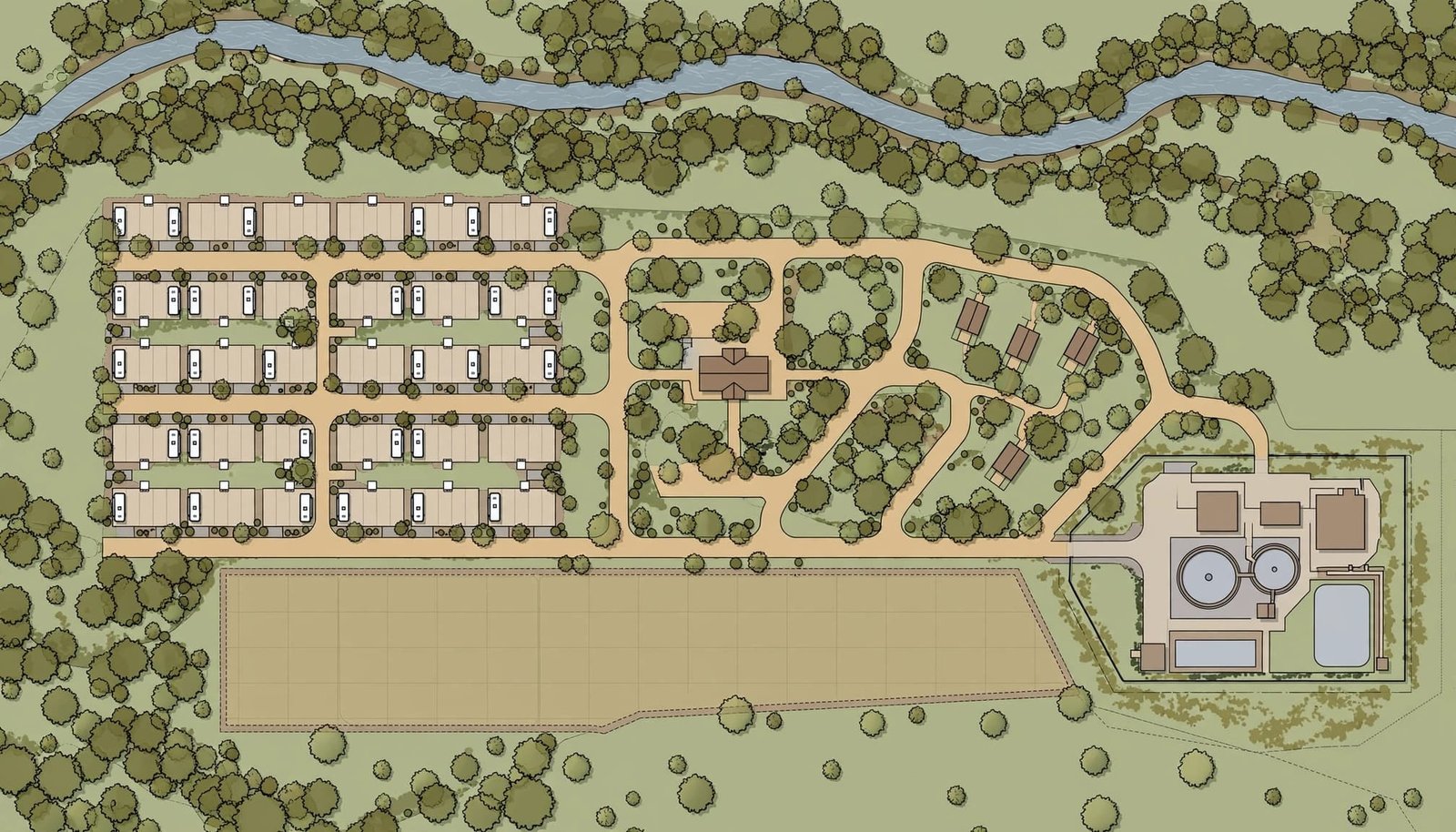
City water and city sewer generally offer more operating predictability than privately maintained wells and septic systems. Municipal connections still bring capacity limits, rate increases, and potential upgrade costs.
Private systems require close attention to age, condition, maintenance, and replacement exposure. The EPA’s onsite wastewater manual explains why system design and maintenance matter.
Have qualified professionals inspect wastewater equipment, electrical pedestals, bathhouses, roads, drainage, and water supply. Get repair estimates into your acquisition budget.
A freshly painted office doesn’t tell you much about buried pipes, y’all.
Treat expansion as a separate investment
An advertised state permit for a 20,000-gallon-per-day treatment plant and unzoned county status can be expansion advantages. Unzoned status doesn’t establish buildability or remove other approvals.
Neither proves that additional RV sites are ready to build. Remaining wastewater capacity, soils, wetlands, access, setbacks, and electrical service still affect feasibility.
Compare the approved layout with existing facilities, the seller’s proposed expansion, and the available acres.
Review legal access, recorded easements, flood exposure, and accessibility. Our commercial accessibility checklist helps organize questions about bathhouses, offices, and common areas.
Extra acres only have expansion value when the intended use is practical and financially worthwhile.
Arrange Financing Without Draining Your Reserves
KOA’s purchase requirements state that buyers need at least $250,000 in cash to purchase a campground. That’s a KOA-specific threshold, not a universal campground down payment, so confirm current requirements directly with KOA.
KOA recommends its Net Worth Estimator to calculate available purchasing funds and its Startup Costs Estimator to identify a suitable price range.
For an independent acquisition, consider conventional financing, SBA-backed loans, and seller financing. The SBA’s lender resources describe 7(a) financing uses that include business acquisitions, real estate, equipment, and working capital.
SBA 504 financing addresses qualifying fixed assets, but it doesn’t fund working capital. Eligibility depends on the operating business and deal structure.
Compare total cash required, monthly debt payments, guarantees, repair reserves, and the effects on cash flow and working capital. A seller note can bridge a financing gap, but it can’t repair weak earnings.
Commercial real estate for lease, sometimes listed as CRE for lease, creates another structure: owning the campground business while leasing its site. Lease duration, renewal rights, rent increases, and improvement ownership become central to the deal.
Build an Offer That Carries You Through Closing
A sound offer covers more than price. It defines the assets, liabilities, contingencies, and transition responsibilities.
Give your attorney, CPA, lender, and inspectors room to do their jobs:
- Establish the purchase structure. Identify whether you’re buying assets or ownership interests, whether land is included, and how equipment, deposits, and reservations transfer.
- Protect the investigation period. Include appropriate financing, appraisal, inspection, title, environmental, and permit-related contingencies, with access to supporting records. Verify zoning and land-use claims, including any claim that the property is unzoned.
- Define the handoff. Put seller training, staff introductions, reservation-system access, vendor relationships, and operational procedures into writing. Even a property marketed as turnkey needs a documented handoff and operational review. If the campground has a KOA affiliation, verify any approval or transfer requirements.
Our commercial title commitment checklist helps organize property-rights review before closing.
Pay attention to prepaid stays and seasonal deposits. The purchase agreement should allocate those obligations so you don’t inherit tomorrow’s guests without the money already collected.
Insurance also belongs in the timeline before your contingencies expire. Premiums, deductibles, flood coverage, and business-interruption terms affect the operating budget.
Finally, schedule training around real operating tasks. Learning utility shutoffs, reservation procedures, and emergency contacts is more useful than a quick tour on closing day. Include introductions to the people who maintain the systems.
Frequently Asked Questions
How profitable is owning a campground?
Profitability depends on occupancy, rates, guest mix, labor, utilities, maintenance, and debt. BizBuySell’s reported median SDE of $149,084 includes a working owner’s financial benefit. It isn’t a guaranteed annual profit or passive investment return.
Assess cash flow after debt service, required repairs, taxes, and reserves. Include replacement management costs before treating the seller’s headline earnings as spendable.
Is buying a campground a good investment?
It can be when documented earnings support the purchase price and the infrastructure fits your budget. Location alone doesn’t make the investment sound.
A property that needs major wastewater work or relies on optimistic expansion assumptions can demand far more capital than expected. The right purchase also fits your management skills and lifestyle.
Buy a Campground You Can Operate With Confidence
A good campground or RV resort purchase supports dependable campground ownership and manageable infrastructure. Keep enough cash in reserve to handle surprises, since the asking price is only one part of the picture.
At B3, we help buyers coordinate valuation, negotiation, financing assistance, and due diligence across Georgia and South Carolina. Bring your goals and budget to the conversation, and let’s work toward a purchase that fits both.
We are Members of the Georgia Association of Business Brokers and Realtors, Commercial Alliance, Georgia Association of Realtors, and National Association of Realtors