
Buying property under a commercial ground lease usually means buying the building and remaining leasehold rights while someone else owns the land. That arrangement can preserve cash, but your long-term control depends on the lease.
If you’re buying a business in Savannah or comparing investment property near Hilton Head, that distinction matters. Before you fall in love with the location, let’s look at what you’re buying, what you’ll owe, and what happens when the lease ends.
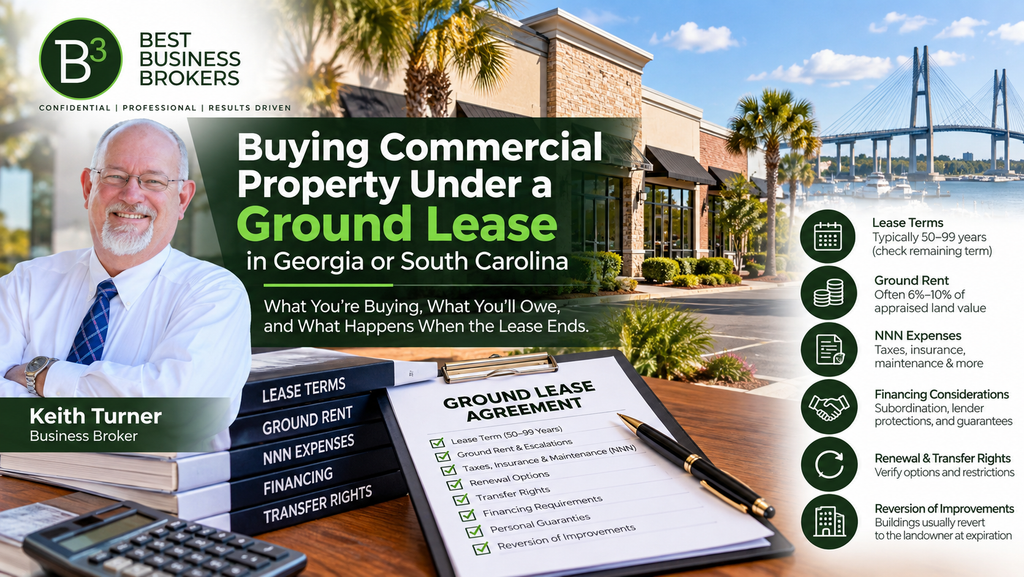
Key Takeaways
- Ground leases commonly run 50 to 99 years, but an existing lease may have far less time remaining.
- Buyers usually pay ground rent plus taxes, insurance, and maintenance, with improvements generally reverting to the landowner at expiration.
- Financing, transfer rights, renewal options, and personal guaranties deserve attention before your purchase becomes unconditional.
What a Commercial Property Ground Lease Transfers
Know which side you’re buying
The landowner is the lessor. The tenant holding rights to occupy and develop the land is the lessee.
Buying the tenant’s interest gives you the remaining contractual rights and its interest in the improvements. Buying the leased land gives you the landlord’s position, including rent collection and future reversion rights.
Those are different investments, folks. One supports operations or building income. The other depends heavily on tenant credit and enforceable lease obligations.
Chains including KFC, Pizza Hut, Taco Bell, Chick-fil-A, Starbucks, and McDonald’s use ground leases to occupy sites without purchasing the land.
The remaining term drives value
Ground leases typically run 50 to 99 years. Some begin with 20-year or 25-year terms and renewal options.
When buying an existing leasehold, the original term isn’t your runway. The remaining years and enforceable options are what matter. Compare the remaining lease term with each renewal option, and verify whether the documents grant a purchase option.
Tenants generally own the improvements they build during the term. At expiration, those improvements usually pass to the landowner unless negotiated otherwise. The landowner already owns the land.
A building with decades of useful life can still become a difficult purchase if its ground lease expires soon.
Buying the Land Versus Buying Leasehold Rights
When comparing commercial real estate for sale with commercial real estate for lease, separate ownership from control.
Here’s how the main choices differ.
| Issue | Fee-simple purchase | Ground-lease interest |
|---|---|---|
| What you acquire | Land and improvements | Leasehold rights and improvement interests |
| Land-related payment | Purchase price and financing | Ground rent with scheduled adjustments |
| Long-term control | Continues with ownership | Ends under the lease terms |
| Exit value | Includes land value | Depends on remaining term and transfer rights |
A land lease can preserve acquisition capital for inventory, hiring, or expansion, but it creates an ongoing land obligation.
For landowners, leasing preserves ownership and produces income. The trade-off is less flexibility over the property’s use for decades. And a building returned years later may need substantial renovation or demolition.
The right choice depends on your goals, available cash, and expected holding period.
Price the Full Ground-Lease Commitment
Ground rent needs a local foundation
Airstream Realty gives a broad estimate of annual ground rent at 6% to 10% of appraised land value. That isn’t a Georgia or South Carolina rate schedule.
At that range, each $1 million of appraised land value translates to $60,000 to $100,000 annually, before other expenses. Location, permitted use, tenant credit, and lease structure affect the negotiated rent.
A rent escalation may be set by an escalation clause using fixed percentages, Consumer Price Index adjustments, or fair-market resets. Weak increases can leave the landowner behind inflation. Uncapped resets can create sharp cost increases for the tenant.
Model every scheduled adjustment through your expected ownership period, including renewal years.
NNN expenses belong in your budget
Most ground leases use a triple net structure, commonly documented as an NNN lease. The tenant pays property taxes, insurance, and maintenance alongside rent. Single-net and double-net variations exist, so the contract controls.
Include building repairs, paving, drainage, storm coverage, and any shared-area charges. In coastal markets, those expenses deserve particular attention.
Our guide to commercial property tax reassessment adds context when comparing leasehold costs with an outright purchase.
Taxes affect returns, too. Under IRS depreciation guidance, most nonresidential buildings use a 39-year recovery period under the general depreciation system. Qualifying improvements can follow different rules. Land itself isn’t depreciable.
Financing Depends on the Lease Language
Subordinated and unsubordinated leases carry different risks
A subordinated ground lease permits the landowner’s interest to sit behind the tenant’s financing lien. Foreclosure can threaten the landowner’s fee interest. Higher rent typically compensates for that added exposure.
An unsubordinated ground lease keeps the landowner’s interest outside that junior position. Rent is generally lower because the landowner takes less financing risk.
The lease should identify the arrangement clearly. Don’t confuse this issue with the priority of an existing mortgage placed by the landowner.
Give the lender workable protections
A leasehold mortgage secures the tenant’s leasehold interest rather than ownership of the land. Lenders need enforceable protections before treating that interest as dependable collateral.
The financing provisions should address:
- Express permission to mortgage and assign the leasehold interest.
- Default notices, lender cure periods, and time to complete foreclosure.
- A replacement lease after specified termination events, where legally available.
- Transfer rights after foreclosure and limits on amendments without lender consent.
An SNDA agreement covers Subordination, Non-Disturbance, and Attornment. Its non-disturbance protections can preserve possession after foreclosure of the landowner’s mortgage. Leasehold-lender recognition requires appropriate language, too.
Bring the lender into negotiations early. A signed lease that can’t support financing won’t serve your goals.
Due Diligence in Georgia and South Carolina

Review the site and the state’s requirements
A 60-to-90-day feasibility period is a negotiating starting point recommended by Amini & Conant, not a statewide entitlement. The agreement must define investigation rights, deadlines, and deposit treatment.
Review surveys, recorded access, utilities, zoning, environmental conditions, and construction obligations. Our commercial title commitment checklist helps organize the title review.
For Savannah, Brunswick, and Hilton Head sites, include flood exposure and storm-insurance costs. A Pooler warehouse or Waycross logistics property also needs an access and truck-circulation review.
South Carolina has a distinct rule: Section 12-37-620’s leasehold provisions place qualifying 99-year leasehold estates on the lessee’s tax account at full land value and impose recording requirements. Don’t apply that rule to Georgia.
Connect the lease to the business purchase
When reviewing businesses for sale, separate operating-company value, building value, and leasehold value.
A business for sale may have loyal customers and strong earnings, yet depend on landlord consent that hasn’t been obtained. Get the full lease, amendments, rent history, renewal notices, and assignment requirements early.
If the term sheet assumes landlord consent, a transfer, or a renewal, check the executed lease for those rights. A preliminary summary doesn’t amend the lease.
Permitted use must cover your operation. Retail exclusives should identify affected parcels and exceptions clearly.
Request a landlord estoppel confirming rent, deposits, defaults, amendments, and outstanding claims. It puts important lease facts in writing.
Protect Your Exit and Your Personal Assets
Leasehold title insurance addresses covered defects affecting the insured leasehold interest. Depending on the policy and endorsements, protection can include rent owed after covered eviction, lost sublease value, and certain relocation expenses.
Old Republic’s ALTA endorsement guide describes leasehold-related coverage. It doesn’t replace a careful review of policy exclusions.
For multiple parcels or divisible ground leases, avoid automatic cross-default provisions that let trouble at one location terminate otherwise performing leases. Separate operations deserve separate risk analysis.
Now, pay attention to the guaranty. In Georgia and South Carolina, signed, clear commercial guaranties generally carry real personal exposure. Your LLC doesn’t shield you from obligations you’ve separately guaranteed.
That exposure can include rent, legal fees, renewals, and other contractually permitted damages. Joint-and-several language can leave one guarantor responsible for the whole covered obligation.
Landlord consent to a lease assignment doesn’t, by itself, release the seller’s personal guaranty.
Negotiate any cap, expiration date, release, or reduction in liability in writing. Address casualty, condemnation, insurance proceeds, and end-of-term restoration as well.
These provisions shape whether you can sell the business, refinance the property, or hand the next owner a workable deal.
Frequently Asked Questions
Can I sell a building that’s on leased land?
Yes, if the lease permits the transfer and its consent requirements are satisfied. The buyer acquires the transferable improvement interest and leasehold rights. Remaining term, rent obligations, and financing protections affect what buyers will pay.
Is a ground lease better than a regular commercial lease?
They solve different needs. A ground lease generally gives the tenant development responsibilities and long-term site control. A conventional building lease provides existing space. When comparing CRE for lease, consider construction costs and repair obligations alongside rent.
What happens if renewal rights are missed?
An option usually requires notice within the contractual window. Missing that deadline can leave the tenant without the expected extension. Put every option deadline on the acquisition calendar, including options needed to support financing or resale.
Does the landowner automatically get a valuable building?
No. Reversion may deliver a useful asset, but an aging or specialized building can require expensive work. Landowners should evaluate restoration duties and future reuse rather than count on a windfall.
Build the Deal Around Lasting Control
A ground lease can support a strong acquisition when the term, total costs, financing, and transfer rights fit your plan. The strongest protection is clear, usable control of the location for as long as your business needs it.
At B3, we help buyers connect business acquisitions with commercial real estate decisions across Georgia and South Carolina.
Bring the lease into the conversation early, y’all. Your business deserves a location agreement that supports the years of work ahead.
We are Members of the Georgia Association of Business Brokers and Realtors, Commercial Alliance, Georgia Association of Realtors, and National Association of Realtors