
Buying an operating restaurant is one thing. Buying the restaurant and the building it occupies is something else entirely.
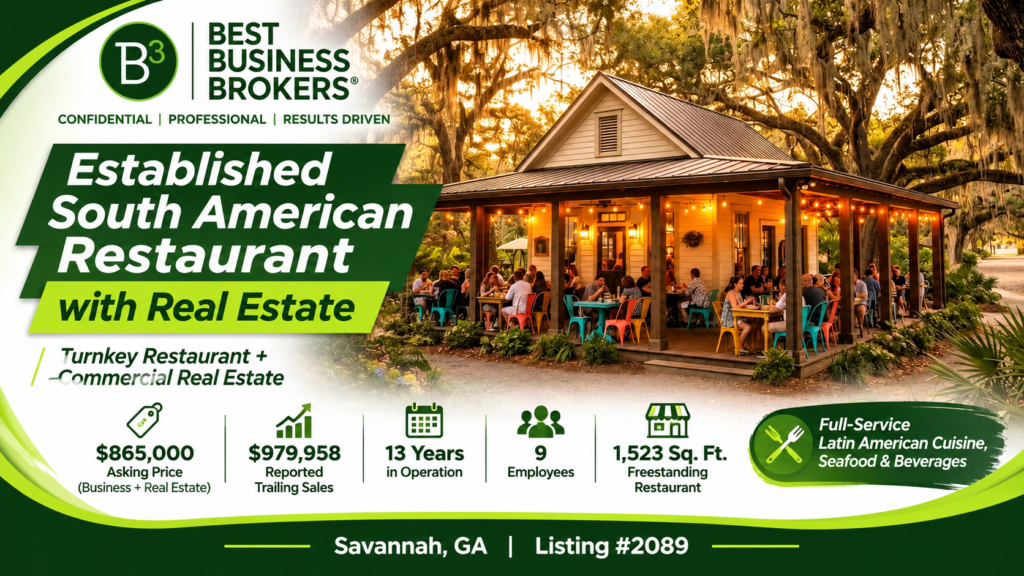
That combination is what makes Listing #2089 stand out: a family-owned Latin American restaurant with 13 years of operating history in the Savannah, Georgia area, offered at $865,000 with the owned freestanding commercial property included in the price.
This is a restaurant for sale Savannah GA with real estate and it represents a valuable opportunity for buyers seeking both a turnkey operation and property.
The seller is retiring, and the business name and exact address stay confidential until a buyer signs a non-disclosure agreement. For anyone searching for a restaurant for sale Savannah GA with real estate attached, this listing checks boxes that lease-only deals cannot. You can review this opportunity along with other businesses for sale in Savannah GA on the B3 Brokers site, then take the steps outlined below.
Key Takeaways
- Listing #2089 offers an established Latin American restaurant plus its owned 1,523-square-foot freestanding building for $865,000.
- Reported trailing sales total $979,958; profit figures are not supplied and must be verified during due diligence.
- The restaurant has roughly 104 seats, nine employees, and 13 years of operating history.
- Savannah’s tourism economy supports restaurant demand, though competition and costs deserve careful study.
- Confidential details are available through David W. Siu at B3 Brokers after signing an NDA.
A Restaurant for Sale in Savannah, GA with Real Estate Included
The $865,000 asking price covers two assets at once: the operating restaurant business and the commercial building it occupies. Deals structured this way are uncommon, and they solve a problem that has cost Savannah restaurant owners dearly. When a landlord declines to renew a lease or raises rent beyond what the business can support, even beloved restaurants can close through no fault of their food or service.
Ownership changes that equation. The buyer controls occupancy and pays no rent to a third party. The buyer holds a tangible piece of Savannah commercial property that continues to exist regardless of how the restaurant performs. For a 13-year-old business, the building adds a layer of stability that a lease simply cannot match. It also gives the next owner options, whether that means operating for decades, refinancing against the property, or eventually selling the restaurant and keeping the land.
Inside an Established Latin American Restaurant in Savannah
This is a family-owned, non-franchise, full-service restaurant serving Latin American cuisine with seafood and an alcoholic beverage program. After 13 years in the Savannah area, it has built the kind of local reputation that takes years to earn and cannot be bought on opening day.
The seller reports that guests consistently praise the food, the service, the atmosphere, and the cleanliness. Those comments come from the seller and have not been independently verified, which is exactly why a site visit matters. Spend an evening in the dining room before you commit to anything. Eat the food, watch the flow of service, and decide for yourself whether the home-cooked character the seller describes holds up in person.
The concept also sits in a niche with limited direct competition in the market, according to the listing. Buyers with questions about the concept or the transition can review the background of David W. Siu, the associate broker handling the sale, who brings 37 years of hands-on food industry experience to the transaction.
Restaurant Financial Highlights for Listing #2089
Here are the numbers the listing provides, stated plainly. The asking price is $865,000. Reported trailing sales are $979,958.
Now the part that matters just as much: reported sales are not profit. The listing does not include cash flow, EBITDA, seller’s discretionary earnings, or net income figures, and no buyer should assume any of them. Revenue tells you the top line; costs determine whether the business actually earns money.
That gap is why due diligence exists. Before making an offer, a serious buyer requests several years of tax returns and financial statements, then reconciles them against point-of-sale records and bank deposits. Food costs, beverage costs, payroll, utilities, and maintenance expenses all come out of that $979,958, and only the documentation reveals how much remains. Buyers who skip this step overpay; buyers who do it well negotiate from strength.
Commercial Restaurant Property in Savannah: What Buyers Get
The real estate in this deal is a freestanding restaurant building of approximately 1,523 square feet. Freestanding means the restaurant occupies its own structure rather than a bay in a shared strip center, which typically brings better visibility, dedicated access, and no shared-maintenance entanglements.
Ownership carries real benefits. There is no monthly rent draining cash flow, no landlord consent required for a transfer, and no risk of a lease non-renewal ending the business. The building can also appreciate independently of the restaurant’s performance.
Ownership carries responsibilities too. The buyer takes on building maintenance, property taxes, insurance, and any capital improvements the space eventually needs. Before closing, standard steps include a professional appraisal, a title search to surface any liens or commercial property easements in Savannah, and a zoning review confirming that restaurant use is permitted at the site.
Seating, Staffing, and Day-to-Day Operations
The dining layout offers roughly 104 total seats: about 80 indoors, 16 on the patio, and 8 at the bar. That mix gives the next owner flexibility across seasons, since patio seating performs well during Savannah’s long warm months while indoor and bar capacity carry the cooler periods.
A staff of nine runs daily operations. Buyers should understand that employees are not guaranteed to stay through an ownership change, and neither are permits or licenses. Food service permits and alcohol licenses do not transfer automatically to a new owner in Georgia. Each requires its own application process, and timing varies, so a buyer’s opening timeline depends partly on how quickly those approvals come through. Building these steps into the acquisition plan early prevents costly downtime after closing.
Why Savannah, Georgia Supports Restaurant Ownership
Savannah gives restaurant owners a demand base that few Georgia cities can match. An estimated 12.9 million visitors came to the Savannah area in 2025 and spent roughly $4.1 billion, according to a Tourism Economics study reported by the Savannah Chamber of Commerce. Visit Savannah’s own visitor economy data shows that spending holding steady at $4.1 billion in both 2024 and 2025, following years of steady growth.
That stability matters, but honesty requires the other side of the ledger. The study itself frames 2025 as a normalization period after the post-pandemic surge, and the local dining scene has seen heavy churn, with well-known closures alongside a steady pipeline of new openings. Rising rents and operating costs have pressured plenty of operators. A buyer should walk the surrounding trade area, count the competing restaurants, and form an independent view of the competitive landscape rather than relying on tourism headlines alone.
Who Should Consider This Restaurant Business for Sale in Georgia
The ideal buyer list is fairly broad. Experienced restaurateurs looking for a second concept with an established customer base fit naturally. Owner-operators who want to run the dining room themselves and build on a proven formula are strong candidates too.
Hospitality entrepreneurs and restaurant groups expanding into the Savannah market may see this as an efficient entry point, since the brand awareness, staff, and layout already exist. Then there is the investor angle: someone primarily interested in restaurant and real estate investment in Georgia who wants income from operations plus long-term ownership of commercial property.
The listing states no specific cuisine experience as a requirement, though anyone who has run a full-service restaurant will find the learning curve far shorter than a newcomer would. Prior restaurant experience genuinely helps.
Growth Opportunities for the Next Owner
The listing suggests several avenues a new owner could evaluate, and it is worth stressing that these are possibilities to assess, not established results or guaranteed revenue growth.
Catering and private events could put the kitchen to work during slow hours. Expanded operating hours might capture demand the current schedule misses. Online ordering and improved digital marketing could widen the customer base beyond walk-in traffic. Customer loyalty programs and menu optimization offer lower-cost experiments, while community partnerships with nearby businesses, hotels, or event venues could build a referral pipeline.
Each idea carries its own costs and operational demands. The right move is to pick one or two, model them against the verified financial from due diligence, and test carefully before scaling.
Due Diligence Checklist Before Making an Offer
A structured review protects buyers from expensive surprises. The essentials for this deal include:
- Financial verification: Tax returns and financial statements for multiple years, reconciled against POS and bank records, since profit figures are not supplied in the listing.
- Cost structure: Food and beverage costs, payroll, and occupancy-related expenses including property taxes, insurance, and maintenance now borne by the owner.
- Equipment and facility: Condition and age of kitchen equipment, hood systems, refrigeration, and the building itself, plus any deferred maintenance.
- Licenses and permits: Food service permit status and the alcohol license transfer process, neither of which transfers automatically.
- Health history: Several years of health inspection records, matched against repair invoices and pest control logs.
- Real estate: Appraisal, title search for liens and easements, zoning confirmation for restaurant use, and a building inspection.
- Operations: Inventory counts, working capital needs, and employment matters for the nine-person staff.
The seller’s stated reason for selling is retirement. Any training, transition support, or post-closing involvement the buyer wants must be raised and documented during negotiations; nothing should be assumed.
How to Request Confidential Details on Listing #2089
Getting past the blind profile takes a few clear steps. First, complete the non-disclosure agreement through B3 Brokers, which protects the seller’s confidentiality while the business stays open. Next, confirm your buyer qualifications, since sellers and brokers both want to know a buyer can close before releasing sensitive information. Then you receive the confidential package with the business name, exact address, financial documentation, and property details.
From there, business and real estate due diligence proceeds with David W. Siu’s guidance, and you can begin on the B3 Brokers website.
Frequently Asked Questions
Is the $979,958 in sales the same as profit?
No. That figure is reported trailing revenue, meaning total sales over the most recent period. Profit depends on food costs, payroll, beverage costs, utilities, maintenance, and every other expense, and those figures are not included in the listing. Buyers verify actual earnings through tax returns and financial statements during due diligence.
What does owning the building change about the deal?
It removes landlord risk and monthly rent from the equation, gives the buyer control over occupancy, and adds a tangible commercial asset to the purchase. It also transfers responsibility for maintenance, property taxes, insurance, and future capital improvements to the owner.
Can I visit the restaurant before signing the NDA?
The business name and exact address stay confidential until a non-disclosure agreement is signed, so an anonymous visit is not possible in a targeted way. After signing, buyers can tour the property and observe operations as part of their evaluation.
Does the seller stay involved after the sale?
The stated reason for selling is retirement. Any training period, transition assistance, or ongoing involvement must be requested and documented in the purchase negotiations. Nothing is guaranteed unless it is written into the deal.
What experience do I need to run this restaurant?
The listing does not require prior experience with Latin American cuisine. That said, experience operating a full-service restaurant makes a significant difference in evaluating the business and stepping into daily operations smoothly.
Talk to David W. Siu About Listing #2089

Opportunities to acquire an established restaurant together with its commercial property are rare in the Savannah market, and Listing #2089 pairs 13 years of operating history with an owned 1,523-square-foot building at $865,000. Interested in owning an established Latin American restaurant and commercial property in the Savannah area? Contact B3 Brokers and complete the Non-Disclosure Agreement to request confidential business information, financial details, and next steps on Listing #2089.
Reach David W. Siu, Associate Broker with Best Business Brokers (GA RE Lic #217603, SC RE Lic #26656), at (912) 349-0940 ext. 10 or david@b3brokers.com. With 37 years of food industry experience, he can walk qualified buyers through every step of this Savannah restaurant acquisition.
We are Members of the Georgia Association of Business Brokers and Realtors, Commercial Alliance, Georgia Association of Realtors, and National Association of Realtors