
Buy a competitor when its customers, people, and cash flow justify the price and transition costs. Open another location when your existing operation runs well without you and you have proven demand in the new market.
Choosing between business acquisition and expansion takes more than enthusiasm for a bigger footprint. You’ve worked hard to build something worthwhile, and the next move should protect that work. Start by comparing what each path asks of your money, your team, and your time.
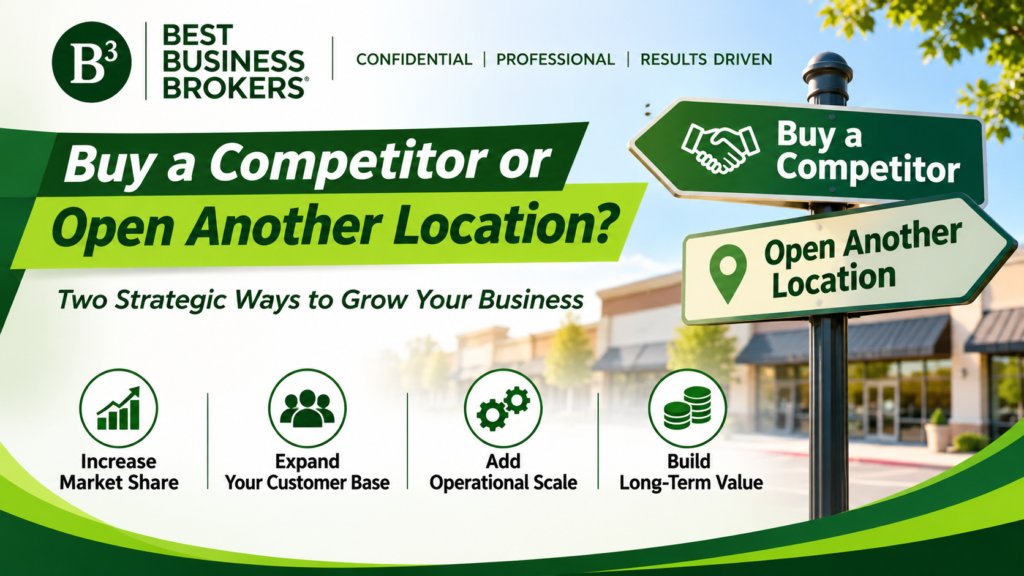
Key takeaways
- Buying can bring revenue sooner, but customer retention, hidden liabilities, and integration determine what you actually keep.
- A second location gives you more control, with startup spending and a longer customer-building period.
- Compare both options using cash flow after debt payments, management pay, equipment replacement, and working capital.
Business acquisition vs expansion: the trade-offs
Business expansion means increasing your company’s sales, capacity, offerings, or market reach. Opening another location is organic expansion. Acquisition is growth through purchasing another company. Acquisitions can bring existing customers and grow market share faster than organic growth, though customer overlap may limit the gain.
A merger joins two companies into one. In an acquisition, the buyer takes ownership; the purchased operation may be absorbed or continue separately.
Here’s how the two main choices stack up.
| Factor | Buy a competitor | Open another location |
|---|---|---|
| Revenue | Existing sales, subject to retention | Sales build after launch |
| Upfront costs | Purchase, diligence, transition | Buildout, equipment, hiring, launch |
| Control | Inherit practices and obligations | Set systems and culture |
| Main risk | Paying for value that disappears | Demand grows too slowly |
| Management | Lead a combined operation | Establish another team |
Neither option automatically costs less. An inexpensive acquisition can need substantial repairs, while an attractive lease can come with an expensive buildout. Shared purchasing or administration can create economies of scale, but only when savings outweigh repair and transition costs.

1. Buy when the business solves a specific problem
Know what you’re buying beyond revenue
Acquisitions can add complementary products, technology, or expertise that would take years to develop internally, helping you gain market share. Combining purchasing or administrative functions can create economies of scale and strengthen your competitive position.
But overlapping customers deserve attention. Adding two sales totals together overstates growth if the same accounts already buy from both companies.
Before browsing businesses for sale, name the advantage you want. More territory? Skilled technicians? A service your customers already request? That answer keeps an appealing listing from pulling you away from your goals.
Test whether the value will transfer
Request monthly sales by customer, renewal dates, canceled accounts, pricing history, and retention by customer cohort. Those records reveal whether repeat revenue reflects lasting relationships or dependence on the seller.
Review receivables, inventory, tax returns, equipment condition, and customer concentration through our business acquisition due diligence process.
A business for sale may show healthy earnings while facing overdue equipment replacements. Verify that projected economies of scale rely on specific purchasing, staffing, or administrative changes. Tie your findings to price reductions, seller repairs, or closing conditions.
2. Open another location when your model is repeatable
Prove demand before signing
Your first location should have documented procedures, dependable management, and results that don’t require your daily rescue. A second address multiplies unresolved problems, too.
For a Pooler expansion, use market research to assess the proposed trade area instead of relying on your Savannah operation’s success. Customer access, competition, parking, delivery routes, and nearby tenants all matter.
Use surveys, polls, targeted ads, or a small-scale service launch for market testing. Paid purchases provide stronger evidence than enthusiastic survey answers.
Price the property and the ramp-up
Compare commercial real estate for sale with commercial real estate for lease using total occupancy costs. Include taxes, insurance, maintenance obligations, improvements, and deposits where applicable.
When evaluating CRE for lease, examine permitted use, renewal options, rent increases, assignment rights, and personal guarantees. A location has to work on paper and in daily operations.
Budget for payroll, insurance, licensing, inventory, and marketing before reliable revenue arrives. Our buying versus starting comparison explores the trade-off between inherited operations and a fresh start.
Compare cash flow, financing, and return
Put both options on the same footing
Build monthly forecasts across the same period for both choices. Include the purchase or buildout, professional fees, financing costs, working capital, and a reserve for setbacks.
Then calculate cash available after operating expenses, debt payments, reasonable management compensation, and necessary equipment replacement. Seller’s discretionary earnings aren’t automatically the cash you’ll take home.
Our Georgia business valuation guide explains the value question behind an asking price.
Compare cumulative cash generated with total cash invested. Payback occurs when cumulative cash returned recovers that investment. Also stress-test lost customers, delayed opening, higher wages, and slower collections.
Existing revenue can arrive sooner than acquisition payback. Your purchase price and debt payments still have to be earned back.
Match funding to the business
Self-funding preserves ownership but uses reserves. Business loans preserve equity but create repayment obligations. The SBA’s 7(a) loan program is one financing route for eligible small businesses.
Seller financing may bridge a valuation gap, with repayment terms and security negotiated in the deal. Grants have restricted eligibility and uses. Angel investors and venture capital exchange funding for equity and influence, and often expect growth beyond a typical local second location.
Keep operating-company and CRE purchase costs separate so each investment’s return remains visible.
Protect the people and systems behind the numbers
Make employee retention part of the deal
The team producing the earnings deserves as much attention as the financial statements. Review compensation, turnover, responsibilities, and dependence on key employees.
Recruiting and retention pressures are documented in SHRM’s 2024 Talent Trends Report. Budget for competitive pay, practical scheduling flexibility, hiring bonuses, and training current employees.
Plan how you’ll explain the ownership change. People want to know who leads them, what changes, and whether their work still matters. Clear answers help protect the relationships you’re paying to acquire.
Plan integration before closing
Decide who owns payroll, purchasing, customer communication, and standard operating procedures. Align cultures and reporting relationships before a larger team exposes unclear responsibilities.
Review software transfer rights, data ownership, account access, cybersecurity incidents, and insurance exclusions. A seller’s password doesn’t transfer a software contract.
Keep sensitive records within a controlled deal team and use secure file sharing. Have your attorney translate material findings into purchase-agreement protections and transition obligations.

Consider growth without another address
The familiar growth routes include entering new markets, increasing sales in existing markets, adding products or services, forming partnerships, and mergers and acquisitions. A second location is only one way forward.
Co-branding, joint ventures, and distribution partnerships can build brand awareness, share costs, and reduce your standalone financial exposure. Good partner management means assigning clear responsibilities, agreeing on economics, and setting exit terms. International expansion into new markets may use exporting, licensing, or franchising. Licensing lets another company use defined brand, product, or intellectual-property rights.
Customer expansion means focusing on renewals and identifying customers who are a good fit to upsell, rather than buying another company. It deserves a separate plan. Existing customers already see you as their established provider, so acquisition messaging that challenges the status quo can undermine a renewal.
Address four different concerns: “Why Stay,” “Why Pay More,” “Why Evolve,” and “Why Forgive.” Explain continued value, added value, the reason for change, or the remedy after a service failure. Don’t give every customer the same pitch.
Measure progress before committing more capital
Track eight measures where they fit your model: customer acquisition cost, customer lifetime value, sales revenue, monthly recurring revenue, revenue growth rate, month-over-month growth, website conversion rate, and churn rate.
The customer acquisition cost formula divides total sales and marketing spending by new customers gained during the same period. Keep the reporting period consistent. Monthly recurring revenue matters for subscription businesses; it shouldn’t be forced onto a business without recurring contracts.
Before committing, work through three decisions in order:
- Set the minimum cash return and maximum cash exposure your existing operation can support.
- Identify who will manage the expansion without weakening the original business.
- Define the results that justify further investment and the point at which you’ll stop spending.
Measure each location or acquired operation separately. Combined revenue can hide a branch that consumes cash.
Questions owners ask before choosing
What percentage of acquisitions succeed?
In Bain’s research on M&A performance, executives report that close to 70% of deals succeed. That’s an executive-reported figure, not a guarantee for your transaction.
Define success before making an offer: retained customers, cash flow, manageable debt, and results against your investment case. A completed closing alone doesn’t establish a successful acquisition.
Can the acquired company keep its name?
Yes. Ownership and branding are separate decisions. You can retain an established brand while changing ownership, subject to the transaction’s rights and terms.
A familiar name may protect customer continuity. Before changing it, determine whether customers value the company brand, the seller’s personal relationships, or both. Put branding decisions alongside the customer transition plan.

Choose the growth your business can support
The right next step leaves your business stronger after the excitement of opening day or closing day passes. Favor transferable value when buying and proven demand when building.
At B3, we help owners connect valuation, due diligence, financing, and transaction terms to their goals. Bring both paths to the table, folks. Your next chapter should make financial sense and leave you with a business you’re glad to lead.
We are Members of the Georgia Association of Business Brokers and Realtors, Commercial Alliance, Georgia Association of Realtors, and National Association of Realtors