
Buying your first business can feel like house hunting in a thunderstorm. Every place looks promising until you spot the leaks. If you are weighing opportunities for first-time business buyers in Georgia or South Carolina, the safest bet usually isn’t the flashiest one.
You want immediate cash flow, repeat customers, and a deal you can understand without a decoder ring. Buying an existing business remains a strategic move for newcomers, and the good news is that both states offer plenty of practical targets, from Savannah service routes to Atlanta niche retail and Hilton Head support businesses.
Let’s talk about the kinds of companies that give first-time buyers the best shot.
Key Takeaways
- The strongest first purchases usually have steady demand, simple operations, and clear financial performance.
- Establish clear acquisition criteria early to narrow your search effectively.
- Home-service companies, laundromats, car washes, and light B2B services are often better starter deals than trend-driven concepts.
- Location matters. Savannah, Pooler, Atlanta, Macon, Warner Robins, Brunswick, Dublin, Waycross, and Hilton Head all reward different business models.
- Don’t ignore the real estate side. CRE, lease terms, and site quality can make or break the deal.
- A good first acquisition should feel understandable, not mysterious.
What makes a first business worth buying
The best first purchase is usually boring in the best possible way. It has customers who come back, staff who know the routine, and numbers that tell a clean story.
Think about it. Would you rather buy a trendy concept with thin margins, or a steady local company that already knows how Friday afternoons work? Most first-time buyers find that buying an existing business is the more reliable path to success compared to chasing risky new ventures.
A business for sale listing should give you more than a pretty headline. It should show seller recast earnings, which help you verify the true business valuation and financial performance, alongside basic staffing details, lease terms, and a reason the owner is selling. If you are browsing a business for sale and those facts are fuzzy, slow down.
When you’re sorting through listings, ask one plain question: “How does this company make money every week?” If the answer takes ten minutes, that’s a problem.
The best first-time buyer businesses tend to share a few traits. They usually have recurring or repeat demand. They don’t depend on one superstar employee. They also don’t need a complete rebrand, full remodel, and new operating system on day one.
Home-service businesses fit that pattern in 2026. So do many light consumer-service companies. Buyers keep chasing companies with existing customers and proven demand because the startup guesswork is already behind them. That’s one reason an established acquisition often beats building from scratch. If you want a practical overview of the buying a business process, start there before you start calling on listings. Since small business loans are a common way to fund these acquisitions, having your financials in order early on is essential.
Your first deal doesn’t need to be glamorous. It needs to be understandable, stable, and priced on real cash flow.
The best business types for first-time buyers
In Georgia and South Carolina, the sweet spot is usually found in service and route-based companies. Why? Because people keep needing them whether the economy feels sunny or a little shaky.
Pest control is a strong example. National demand is large, recurring, and local. HVAC, plumbing, pool service, and roofing also stay busy because homeowners do not stop needing repairs. That same pattern shows up in landscaping, lawn care, debris removal, and other practical services. If you are struggling to narrow down the options, consulting a business broker can help you identify which service-based listings have the best route density and long-term stability.
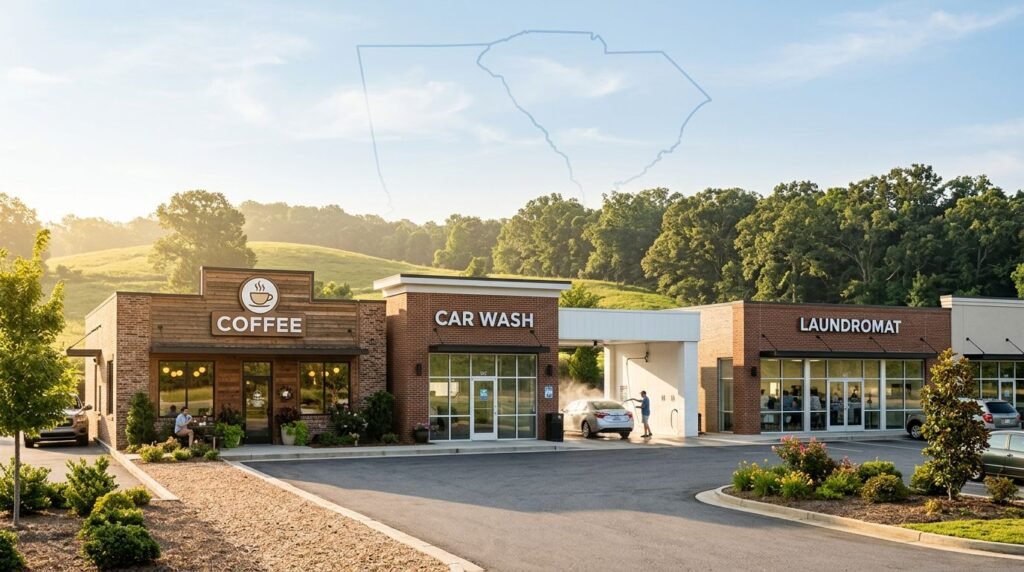
Laundromats and car washes still attract first-time buyers, too. They are not magic money machines, but they can be easier to understand than a restaurant with food waste, labor swings, and daily inventory headaches. Exploring a franchise option is also a popular path for those looking for established systems that simplify the early stages of ownership.
Even broader 2026 trend coverage from the U.S. Chamber’s business idea report points in the same direction, practical businesses with clear demand keep winning attention.
Here’s a quick side-by-side look:
| Business type | Why it works for first buyers | What to watch |
|---|---|---|
| Pest control, HVAC, plumbing, pool service | Repeat customers, route density, strong local demand | Licensing, technician retention, fleet costs |
| Landscaping and lawn care | Simple offer, easy-to-see demand, room to grow routes | Seasonality, equipment replacement, weather |
| Laundromats and car washes | Familiar model, steady traffic, possible semi-absentee ownership | Utilities, deferred maintenance, site quality |
| Light B2B services and niche retail | Lower inventory risk in some models, easier to learn | Customer concentration, weak margins, stale stock |

The takeaway is simple. Buy the business you can operate well, not the one that only looks exciting in a teaser.
One caution here: med spas are hot, but they are not always ideal first buys unless you have the right operator, compliance setup, and local market. Food service can work, too, but it often asks more from a new owner. More labor. More spoilage. More moving parts. That is fine if you know the trade. It is rough if you do not.
Where Georgia and South Carolina buyers have an edge
Savannah and Pooler are attractive for service businesses tied to rooftops, roads, and logistics. Pest control, HVAC, plumbing, cleaning, and light industrial support all make sense in a market with port activity, new housing, and steady in-migration. Because navigating these local market nuances can be complex, working with a business broker can help first-time buyers find a route business in Pooler that is easier to scale than a concept restaurant downtown.
Atlanta gives buyers sheer volume. You will find more options in business services, light retail, specialty fitness, and owner-operated service firms. You will also face more competition. That means discipline matters, and because it is easy to overpay for a polished story in a big market, consulting an M&A advisor can provide the deeper insights you need to understand the competitive landscape.
Macon and Warner Robins often make more sense for first buyers who want lower overhead and a strong local customer base. Contractor services, auto repair, cleaning, and practical neighborhood retail can pencil out better there than in pricier metros. A local business broker can assist in evaluating these opportunities, especially for those looking at Dublin and Waycross, where success often depends on valuing community ties and operating control over trendiness.
Brunswick and Hilton Head have their own rhythm. Coastal demand supports marine-adjacent services, landscaping, housekeeping, laundry, pool service, and hospitality support companies. In South Carolina, retail vacancy held near 4.1 percent through 2025, which tells you good neighborhood space is still in use. Office leasing has also shown signs of recovery in better buildings, so local service firms that need visible space may find workable options there.
If you are comparing markets across Georgia, the state’s small business support network is worth knowing about. It gives buyers a clearer picture of the industries, contacts, and local resources behind the headlines.
Don’t treat CRE like an afterthought
A lot of first-time buyers focus on earnings and skip the property question. That is how people walk into expensive surprises.
Some deals include the real estate, which makes the property a core part of your asset acquisition strategy. Others depend on a lease that can turn sour fast, significantly altering your deal structure. If a listing comes with Commercial Real Estate for sale, you need to know whether the building helps the deal or drags it down. Is the site functional? Is there room for trucks, storage, parking, or expansion? Can the business still work if interest rates stay firm?
The lease side matters just as much. A service company can have healthy books and still be boxed in by bad rent, weak renewal options, or landlord restrictions. That is why CRE belongs in the first conversation, not the last one.
You will also see listing language around CRE for Lease and Commercial Real Estate for Lease. Read those details carefully. A Pooler HVAC company may need yard space. A Savannah marine service business may need warehouse access. A Hilton Head cleaning company may care more about route proximity than storefront appeal. An Atlanta med spa may live or die by parking and visibility.
The same goes for search filters. Commercial Real Estate for sale can open a better long-term play, while CRE for Lease may keep your cash free for working capital. Neither is automatically better. The right answer depends on the business, the market, and your financing plan.
A cheap business with a bad lease isn’t cheap.
How to keep a good deal from turning bad through due diligence
Trust your eyes, but trust the numbers more. Performing thorough due diligence is the most important step in protecting your investment. If revenue is climbing, you should see it in bank deposits, tax returns, and customer activity, rather than relying solely on a seller’s narrative.
The process usually begins by signing a non-disclosure agreement to protect the seller’s privacy. Once you and the seller agree on a letter of intent, your deep dive into their tax returns and operational records begins in earnest. Start with the basics. Check customer concentration, seasonality, payroll structure, equipment age, and any required licenses. Ask whether key employees are likely to stay, how much business comes from a single referral partner, and what happens to operations if the owner disappears for 30 days.
You should never navigate this process alone. Building an advisory team, including a trusted accountant and attorney, is essential to verify if the purchase price is actually justified by the financial health of the company. Do not skip the lease review, either; for many first-time deals, the rent line is almost as important as the top line.
If you want a grounded checklist for the hard questions, this guide on how to evaluate a business opportunity and navigate due diligence is a smart place to start. It helps you test whether the asking price matches the underlying facts of the operation.
Y’all do not need a perfect deal, as nobody ever gets that. You need a fair deal, in a market you understand, with risks you can name out loud.
Frequently Asked Questions
How much cash do I need to buy a business in Georgia or South Carolina?
While the exact amount depends on the purchase price and your financing structure, most buyers should plan for a down payment of 10% to 25% of the total acquisition cost. Using an SBA loan can help lower that cash requirement, but you will also need extra working capital to cover initial operations and unforeseen expenses.
Is it better to buy a business or start one from scratch?
Buying an existing business typically offers a faster path to cash flow because you inherit established customers, operational systems, and trained staff. Starting from scratch avoids the risk of inheriting bad habits, but it requires significantly more time to build a brand, acquire a customer base, and refine your processes.
How can I tell if a business listing is legitimate?
Look for clear financial transparency, such as verified tax returns and seller recast earnings that explain the company’s true profitability. If a seller is unwilling to provide documentation or if the business model seems too complex to explain simply, you should proceed with extreme caution or walk away.
Do I really need to hire a team of advisors?
Yes, navigating a business acquisition involves legal, financial, and tax risks that are difficult to manage alone. An experienced attorney, accountant, or business broker can help you verify the numbers, negotiate a fair lease, and ensure you do not inherit hidden liabilities.
Final Thoughts
Your first business acquisition should not feel like a moonshot. Instead, it should feel like a calculated, solid step toward your professional goals.
Georgia and South Carolina offer excellent territory for your first purchase, particularly within service companies, route businesses, laundromats, car washes, and other simple local operators. When the cash flow is consistent and the lease terms make sense, your first acquisition stops looking like a gamble and starts looking like a sustainable plan. Keep in mind that successful mergers and acquisitions in the small business sector are built on stability rather than speculation.
As you move toward closing, ensure you have explored the most viable funding sources, such as SBA loans, seller financing, or various forms of equity financing. Protecting your investment requires careful attention to the final closing documents, specifically your bill of sale and the non-compete agreement, which help solidify the transition. Finally, do not hesitate to lean on a trusted advisory team to guide you through the complexities of the deal and help you cross the finish line with confidence.
We are Members of the Georgia Association of Business Brokers and Realtors, Commercial Alliance, Georgia Association of Realtors, and National Association of Realtors