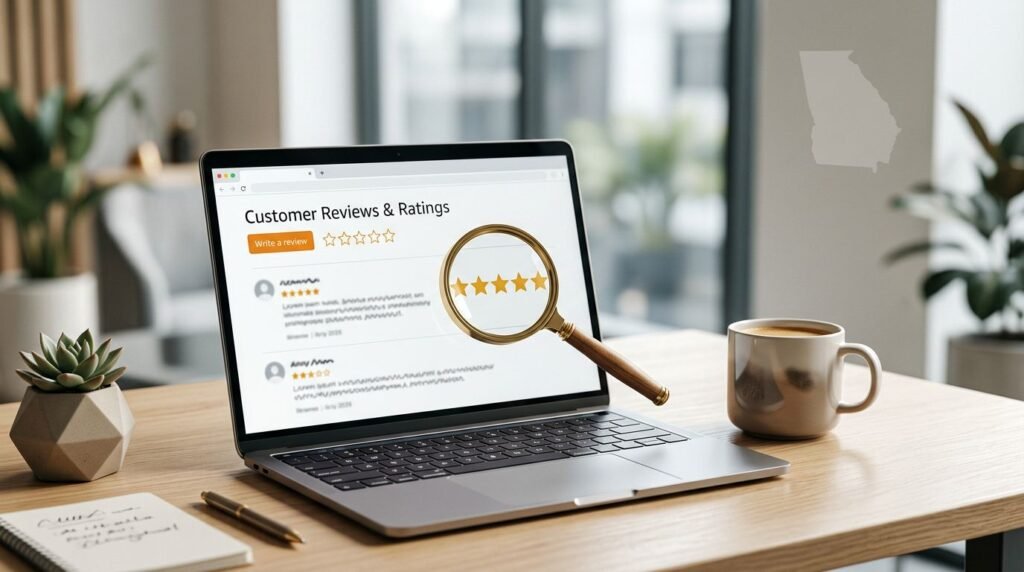
Buying a company without reading the reviews is like buying a house without opening the closets. The polished parts show first, and the public-facing Google Business Profile often highlights only the best features while the real problems hide in the corners.
If you are sizing up a Georgia deal, google reviews georgia business listings can tell you what the sales prospectus won’t. They can expose repeat service issues, staff problems, cleanliness concerns, and customer habits that do not show up in a profit and loss statement.
Let’s look at how to review Google feedback on a Georgia business in a way that helps you buy smarter, not just faster.
Key Takeaways
- Prioritize patterns over star ratings: Don’t be misled by a high star count. Focus on recurring themes in customer comments to identify genuine operational strengths or weaknesses.
- Context matters: Evaluate complaints based on the specific local market and business type. Issues that are major red flags in one Georgia town might be standard expectations in another.
- Audit management style: Analyze how the current owner responds to negative feedback. Their tone—whether calm and solution-oriented or defensive and combative—reveals how they lead and handle pressure.
- Beware of fake reviews: Use your instinct to identify suspicious clusters of vague, 5-star reviews or coordinated negative campaigns, as these can obscure the true reputation of the business.
Start with patterns, not the star count
A star rating is a headline, not the whole story. The real value sits in the comments, the timing, and the repetition.
When buyers review Google reviews on a Georgia business, the first mistake is chasing a perfect score. A 5.0 can look great and still be shaky. A 4.3 with detailed, genuine feedback may be far more trustworthy. When evaluating these scores, effective Google review management involves looking beyond the surface level. A 4.3 score often contains a healthy mix of positive reviews and negative reviews, which usually indicates a business with a transparent and realistic customer base. Real businesses have friction; a delayed order here, a bad day there, or a customer whose expectations were never realistic are all part of the process.
What matters is pattern recognition. If ten people mention rude counter staff, that is not random. If six reviews over three months complain about long wait times, that points to an operating issue. If one angry customer blows up over something odd from 2021, that is different.
This quick screen helps keep your eye on the right details:
| What to check | What it can tell you |
|---|---|
| Recent 1-star reviews | Current trouble, not old history |
| Repeated complaints | Operational weakness |
| 2-star and 3-star reviews | Balanced feedback with useful detail |
| Review dates | Whether problems are fading or getting worse |
| Photos from customers | Real-world condition of the business |
Two-star and three-star reviews are often gold. Those customers usually liked some things and disliked others, which means they are more likely to tell the truth in plain English.
The stars catch your eye. The repeated words should drive your decision.
If you are looking at Atlanta local businesses, a Savannah cafe, or a Macon retail shop, ask one simple question: what do customers keep saying? That is where the signal lives.
Match the reviews to the market and the property
Not every complaint means the same thing in every town. Context matters, y’all.
A restaurant in Savannah may get slammed by tourist traffic on weekends, while a Pooler auto repair shop depends on repeat local customers. A tour business near Hilton Head may get seasonal reviews from visitors who don’t know the area. A Brunswick marine company or a Waycross industrial supplier lives in a different rhythm entirely. You have to read reviews through the lens of the business model and the local market.

A polished listing labeled Business For Sale can hide location pain that customers mention every week. Parking trouble, hard-to-find entrances, poor signage, and unsafe access after dark are common issues. These factors directly influence your Google Maps visibility and can ultimately limit the daily revenue the Georgia business owner is able to capture.
The same goes for real estate. If the deal includes CRE or Commercial Real Estate for sale, review photos and complaints about access, building condition, neighboring tenants, and lot maintenance. If the company operates from space under a CRE for Lease or Commercial Real Estate for Lease setup, comments about a broken parking lot, poor lighting, or a hard-to-enter center can still become your problem after closing.
This is where browsing businesses for sale gets real. You are not only buying earnings. You are buying a reputation attached to a place, a process, and a customer expectation.
In Atlanta, customers may forgive parking hassles if service is excellent. In Dublin or Warner Robins, repeated complaints about basic courtesy may hit harder, because word travels faster and community memory lasts longer. Local context does not excuse bad reviews, but it helps you interpret them the right way.
Read the owner’s responses like you’re interviewing them
A business owner’s replies can be as revealing as the reviews themselves. Sometimes more. When you analyze how they handle online reputation management, you get a clear look at their leadership style and temperament.
When a customer leaves a rough review, does the owner stay calm? Do they acknowledge the issue? Do they offer a fix, or do they fight in public? That tone tells you how the business handles pressure, and that is a big deal when you are about to step into the owner’s shoes. Look for a pattern in their Google review management. One defensive answer does not sink a deal, but ten sarcastic replies certainly do. If the owner blames every customer, every employee, and every delay on someone else, pay attention. That mindset often spills into staffing, training, and vendor relationships.
On the other hand, a simple response like, “We’re sorry, please call us so we can make it right,” shows a business that still cares about recovery. That is not fluff. That is culture in public view.
Google’s own tips for getting more reviews push businesses toward natural customer feedback and conversational engagement. That makes a stiff, combative, or oddly promotional response stand out even more.
Photos matter here too. Customer photos can confirm whether complaints are fair. If people mention dirty restrooms, broken fixtures, faded merchandising, or old equipment, the pictures may back it up. For a buyer, that is useful because it connects reputation to capex. A review is not only about hurt feelings. Sometimes it is a preview of repair bills.
If several customers in Savannah, Macon, or Brunswick say the same thing, and the owner keeps replying with excuses, trust what you are seeing. You are not reading comments anymore. You are reading management behavior. If you decide to move forward with the purchase, remember that you can eventually contact Google support for Google review removal if you inherit a business profile plagued by clearly illegitimate or policy-violating feedback.
Learn to spot fake, padded, or suspicious reviews
Some review profiles look a little too clean. Trust that instinct.
A healthy review page usually has variety. Different writing styles and levels of detail are common. Some happy customers gush, others stay brief, and a few complain. That is normal. What raises eyebrows is a sudden flood of fake 5-star reviews that all sound alike, especially after months of silence.
Watch for clusters. Did the business get 18 five-star ratings in nine days, all with vague praise? If several reviewers have no profile photo and no history, you are likely looking at paid Google reviews. Fraudulent reviews often emerge during review bombing campaigns, where a business is either trying to inflate its image or is being targeted by competitors.
Be aware of the review extortion scam. Some business owners receive extortion emails threatening a flood of fake 1-star reviews unless a payment is made. This criminal extortion scheme often leads to extortion attempts that leave the business profile looking erratic. If you see a cluster of negative posts that lack specific details, they may be fake 1-star reviews meant to damage the company’s reputation.
If you think these common Google review scams never happen, spend a minute reading this discussion about paid Google reviews. The market exists, so buyers should keep their eyes open. You should always flag suspicious reviews that appear to be part of a coordinated effort. Taking the time to report fake reviews helps you gauge the true integrity of the business owner.
Another clue is imbalance. A spotless 5.0 rating can feel less believable than a 4.4 with a few fair complaints. Real customers do not all sound the same, and real operations do not run without a single hiccup.
Look at the bad reviews in context. If one-star posts accuse the company of fraud but the language is wild and unsupported, stay calm. If several reviewers mention the same billing issue, missed deadline, or no-show pattern, that is different. Repetition is what matters.
For anyone evaluating a Georgia business through Google reviews, this is the rule: do not ask whether a page looks good. Ask whether it looks real. A believable reputation is worth more than a polished one.
Turn review themes into due diligence questions
Reviews should never make the decision by themselves. Instead, they should shape your questions. Think of them as witness statements that point you toward the areas that need inspection. You then verify what you found with financials, staff interviews, vendor data, site visits, and lease or property documents. Using this systematic approach is a vital way to protect your business during the acquisition process.
Here are four questions worth asking after you read the review history:
- Are these complaints still happening, or were they fixed six months ago?
- Do the review themes match staff turnover, refunds, warranty claims, or declining sales?
- If customers keep mentioning the location, does the lease or property setup explain why?
- Has the seller changed systems, managers, pricing, or vendors in response?
When analyzing negative reviews, look to see if the current owner has any evidence for appeal regarding claims they argue are inaccurate. This is where a buyer separates noise from risk. A Warner Robins repair business with repeated complaints about wait times may simply need stronger scheduling. An Atlanta retailer with constant accusations of bait and switch pricing is a different story. A Pooler restaurant with old complaints and strong recent reviews may be healing. A Waycross operation with fresh cleanliness photos and defensive replies may need a harder look.
If you want a broader frame for the process, this guide to buying a business is a solid place to start. For a sharper due diligence lens, this piece on evaluating a business for purchase pairs well with review analysis.
The best buyers do not stop at the idea that people seem happy. They ask why customers are satisfied, why some are not, and whether the problems are fixable under new ownership. That is how you turn Google reviews from background noise into deal intelligence.
Frequently Asked Questions
Why are two-star and three-star reviews considered the most valuable?
These reviews are often the most honest because they come from customers who had a mixed experience. They are less likely to be biased by extreme anger or brand loyalty, giving you a clearer picture of what the business does well and where it fails.
Should I be worried if a business has a few negative reviews?
Not necessarily. Real businesses experience friction, and a few negative reviews often indicate a transparent and realistic customer base. You should only be concerned if those negative reviews reveal a persistent, repeating pattern of the same operational issues.
How can I tell if a business is using fake reviews?
Look for unusual spikes in 5-star ratings that lack detail or appear in a very short timeframe. If most positive reviews sound generic and come from profiles with no history or photos, it is a strong indicator that the reputation has been artificially inflated.
How do I use Google reviews to help with due diligence?
Treat reviews as witness statements that guide your formal investigation. If customers repeatedly complain about a specific issue, like long wait times or poor billing, bring those topics up during staff interviews and cross-reference them with the business’s financial and operational data.
Final thoughts
A seller can polish a listing, but customers usually won’t. That is why smart buyers read every review with a calm eye and a sharp pencil. Before finalizing any purchase, ensure you have thoroughly vetted the company’s Google Business Profile to uncover the operational truths hidden in public feedback.
When you are buying a Georgia company, the real value is not in the star count. It is in the patterns. Open the closets, read what repeats, and let the public record show you exactly what to expect when you research google reviews georgia business opportunities.
We are Members of the Georgia Association of Business Brokers and Realtors, Commercial Alliance, Georgia Association of Realtors, and National Association of Realtors